




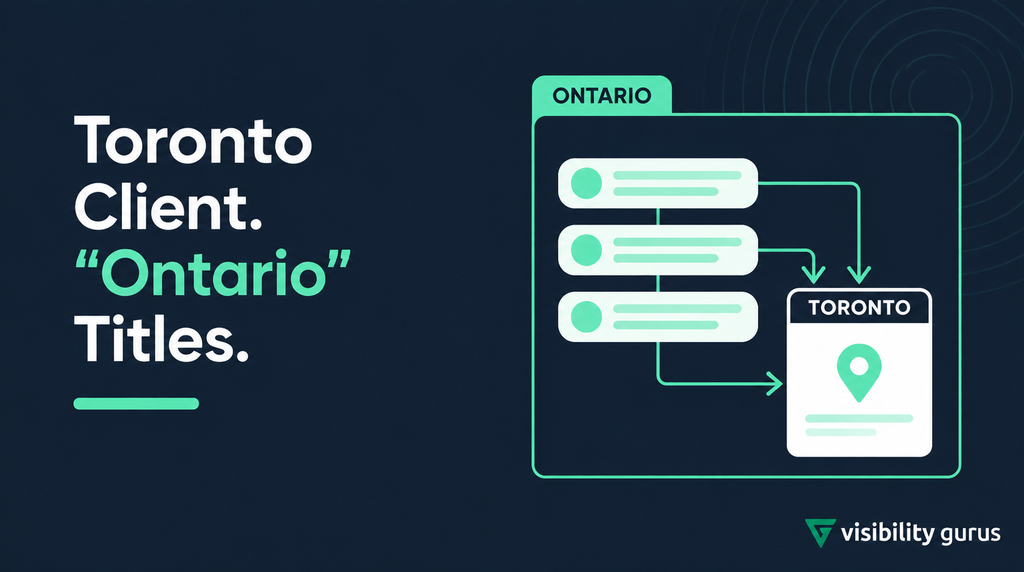

Most content strategies begin with a keyword list. This one began with a contradiction we couldn’t move past.
The Question That Came Up
The client came to us through a white label SEO partnership – a Toronto personal injury firm, with the content strategy on our side.
While analyzing blog topics from their competitors, a pattern showed up almost immediately. Offices in Toronto. Service pages optimized for Toronto. Toronto reviews, Toronto local packs, Toronto landing pages. And then the blog:
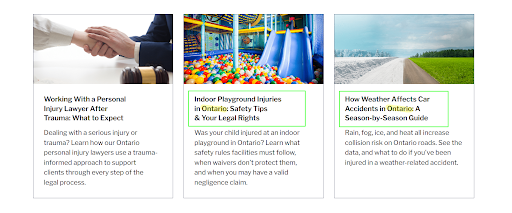
Not one title said Toronto. Where a location appeared at all, it was Ontario and it carried through into the descriptions too.
That left a question worth answering before we wrote a single topic: if the firm is based in Toronto, targets a Toronto audience, and its primary keywords are Toronto-focused, why does the blog drop “Toronto” entirely?
There were only two explanations. Either every competitor was making the same mistake, or every competitor was doing it on purpose. We wanted to know which one before committing a client’s content calendar to either answer.
What We Did First
We took the competitor topics the client had shared and ran them through Claude with a direct prompt:
Prompt:
| act as content strategist below are the few example of my competitor blog topics 1. Indoor Playground Injuries in Ontario: Safety Tips & Your Legal Rights 2. How Weather Affects Car Accidents in Ontario: A Season-by-Season Guide 3. Accident Benefits vs. a Tort Claim in Ontario: The Two Claims Every Injured Person Actually Has If the law firm is based in Toronto, targets a Toronto audience, and its primary SEO keywords are Toronto-focused, why do competitors use “Ontario” rather than “Toronto” in most of their blog topics? |
What Came Back
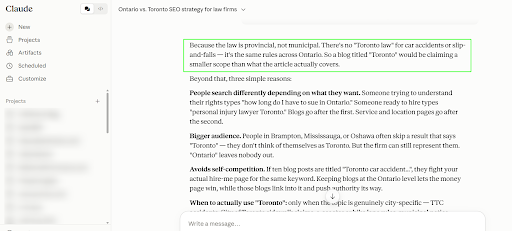
The core of it was the first line: the law is provincial, not municipal. There is no separate Toronto law for a car accident or a slip-and-fall. The rules are the same across the province. A title that says “Toronto” is claiming a narrower scope than the article actually covers.
Three reasons followed from that.
1. Search intent splits by page type. Someone trying to understand their rights searches “how long do I have to sue in Ontario.” Someone ready to hire searches “personal injury lawyer Toronto.” Blogs answer the first query. Service and location pages answer the second. The modifier has to match which one the page is for.
2. Reach. Someone in Brampton, Mississauga, or Oshawa scrolls past a result that says Toronto, because they don’t think of themselves as Toronto — even though the firm can represent them. Ontario leaves nobody out.
3. Self-competition. Ten blog posts titled “Toronto car accident…” end up fighting the firm’s own hire-me page for the same keyword. Holding the blogs at the Ontario level lets the service page win, while those blogs link into it and push authority its way.
There was also a caveat that mattered as much as the rule itself: use “Toronto” when the topic is genuinely city-specific — TTC incidents, City of Toronto sidewalk claims, municipal notice periods. In those cases the city isn’t a modifier, it’s the subject.
Why We Took It to the Client Instead of Acting on It
We could have started writing at that point. The logic was clean and the competitor evidence was consistent across every firm we looked at.
We didn’t. Through the agency, we shared the finding, the reasoning, and the competitor examples to get his take on the content strategy direction.
The Client’s Response
He confirmed it, and said he was glad the question was raised before the work started rather than halfway through it.
We added one condition of our own. “Ontario” in the title works for accuracy and reach, but it pulls the local signal out of the most visible part of the page. So every article carries that signal elsewhere:
- “Toronto, ON” worked into the introduction naturally, not bolted on
- Examples drawn from Toronto – the roads, intersections and collision reporting centres people there actually recognize
- A Toronto-specific FAQ block closing out each piece
- Internal links pointing back to the Toronto service pages
Provincial title, local body. The article competes for the provincial informational query and still makes it unmistakable where the firm is.
He agreed to that as well.
Then We Built the Topics
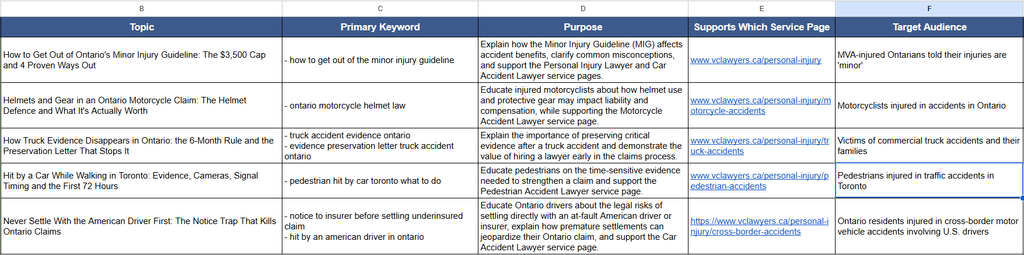
Each topic went into the calendar with the month, the primary keyword, the purpose of the piece, the service page it supports, the target audience, and its approval status. Nothing went on the list without those filled in. A topic that couldn’t name the service page it fed wasn’t a topic, it was a guess.
The Ontario convention held across the calendar – MIG and accident benefits, motorcycle helmet defence, truck evidence preservation, the cross-border notice trap. One row broke it: a pedestrian topic built around Toronto evidence, cameras, and signal timing. That’s the caveat applied. The topic is about how one city’s infrastructure produces evidence, so the city belongs in the title.
Why It Mattered
The decision itself was small – one word, in a title convention. What made it worth stopping for was where it sat in the sequence. Titles set the keyword targets, keyword targets set the intent, and intent decides which page ranks for what.
Getting it wrong wouldn’t have announced itself as a mistake. It would have shown up quietly, months later, as a blog competing with its own service pages.
That’s why we asked before we wrote.