




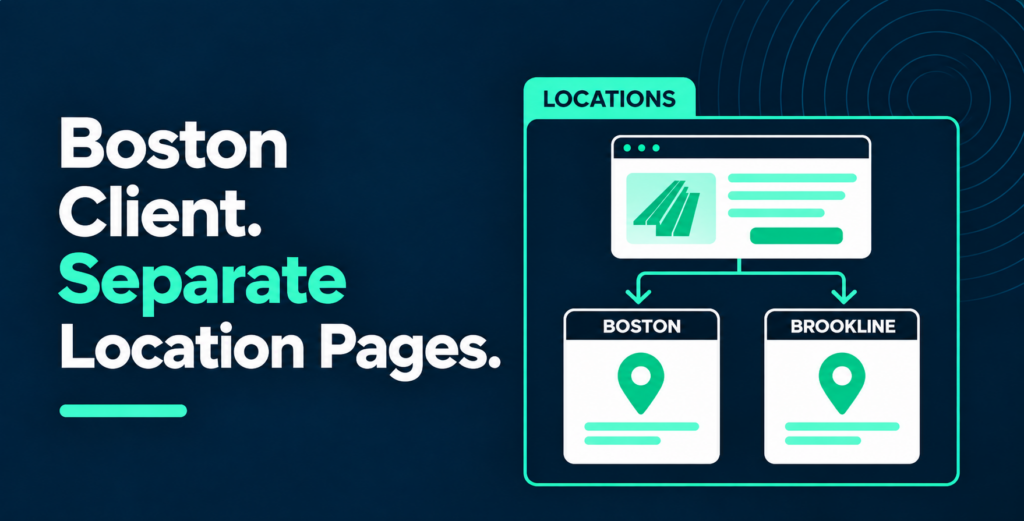

Location targeting is one of the easiest things to get wrong on a local business website, mostly because the shortcut feels efficient. If a business serves two nearby cities, putting both on one page seems sensible. It keeps the site lean, saves writing time, and on the surface it looks like every market is covered.
We come across this often in the audits we run through our white label SEO services, where agencies bring us in to review their clients’ sites and deliver recommendations under their own brand. This case involved a vinyl flooring company in the Boston area. Here’s what we found, what we recommended, and how we made the change easy for the client to understand.
What We Found
During the website audit, we found a single page covering two markets:
abc.com/vinyl-flooring-boston-and-brookline/
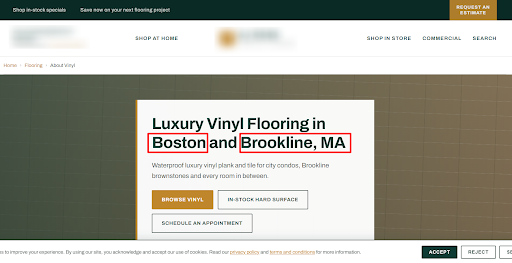
The page targeted both Boston, MA and Brookline, MA with the same URL. Both city names appeared throughout the content, which meant a single page was trying to rank for two separate locations.
When we analyzed the complete page, we realized it wasn’t wrong about either city. The actual problem was that it couldn’t be fully about either of them. The service area covered two places, the project examples were split between them, and the directions applied to whichever location the reader assumed was theirs. In short, the page was built to answer two questions but gave each one only half an answer.
What We Recommended
A parent service page, with a location page under it for each city:
- Main service page → abc.com/vinyl-flooring/
- Boston → abc.com/vinyl-flooring/boston-ma/
- Brookline → abc.com/vinyl-flooring/brookline-ma/
The parent page explains the service itself. And each child page explains that same service for one specific location: the local service area, the neighborhoods covered, project examples from that city, directions and location-specific FAQs.
How We Verified Our Idea
Before sending the recommendation, we ran the structure past ChatGPT:
| Review the following website structure and location targeting from both an SEO and user-experience perspective. Current Situation abc.com/vinyl-flooring/ is a single page that targets vinyl flooring services for two separate cities, Boston, MA and Brookline, MA. Questions to Evaluate Is one page enough to target two different cities, or should each city have its own page? Can a single page rank well in local search and Google Maps for both cities at the same time? Does the URL clearly communicate the service and the location to both users and search engines? Would a parent service page with separate location pages under it be a better structure? Keep the explanation simple and practical. Focus on local search intent, topical relevance, website hierarchy, user navigation, and SEO, rather than only whether the URLs technically work. |
Response From ChatGPT –
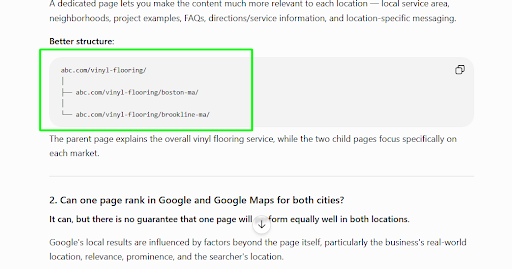
The response returned our idea – the same parent-child structure we had recommended. It also made a point worth keeping. A single page can rank in both cities, but there is no guarantee it performs equally well in either, because local results depend on things the page does not control: the business’s real-world location, its prominence, and where the searcher is.
Separate pages do not buy a ranking. They remove an obstacle the site created for itself.
Potential SEO Impact After Fixing the Issue
The new structure makes the service, the locations, and the search intent clearer to both Google and users, which directly supports local ranking and Google Maps visibility.
Let’s give you the detailed review-
- No keyword cannibalization between Boston and Brookline – One page chasing both cities competes with itself for both. Two pages each own one.
- Each service area gets its own landing page – A Google Business Profile listing works better pointing at a page specific to that location than at a shared page naming several. The pages support the listings.
- Clearer navigation for users and for Google – Someone in Brookline lands on a page about Brookline, with Brookline examples and a Brookline service area, and does not have to work out which half applies to them.
- A scalable structure – Any new city can be added under the same directory later, in the same pattern. Nothing has to be restructured to make room for it.
How We Presented it
We did not send the agency a list of URLs. We created a navigation summary instead:
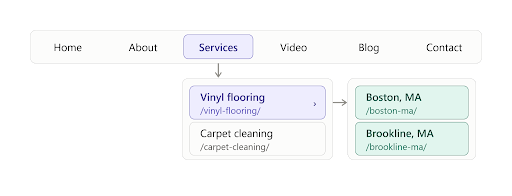
As you can see – services are kept at the top level. Vinyl Flooring and Carpet Cleaning beneath it as separate services. Boston and Brookline branching off vinyl flooring as child pages. This format was designed keeping in mind the end-client.
Why It Mattered
The original page was not broken. It ranked for something. It loaded fine. It described a real service the company performs in two cities it really serves.
It just could not commit to either one. That left Google to decide what the page was about.