





The request was for more organic traffic and more leads. The usual answer to that is new content. But, we started somewhere else.
What We were Asked for
This client came through a white label partnership with a UK agency. They were actually a technical SaaS company and this was the brief: do improvements to the website and create blogs that would increase organic traffic and generate leads.
Before getting there, we decided to figure out why the existing blog is not performing as expected.
Where We Looked First
We pulled 90 days of Google Search Console data and then sorted it for the worst performers -blog posts with fewer than 100 impressions over the full period.
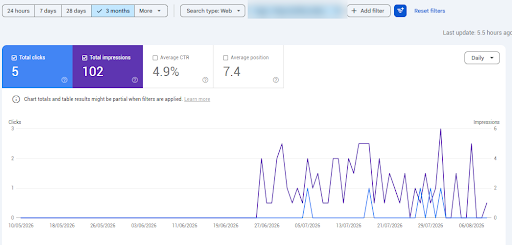
That threshold matters. A post with 100+ impressions in three months isn’t ranking badly. It’s rarely being served at all. Ranking position 40 for a term people search is a different problem from not being considered a candidate for anything.
Which made these posts the right starting point, for three reasons.
- They already exist. Indexed, linked to internally, with whatever history and authority they’ve accumulated.
- They’re evidence, not guesses. A new article is a bet on what might work. A post with 90 days of near-zero impressions is a finished experiment with a clear result, and the GSC query data says what it almost ranked for.
- Adding new content on top of a weak blog compounds the problem. If existing posts are outdated or overlapping, publishing more gives search engines more of the same to sort through.
What We Used AI for
For each selected post, we handed Claude three things: the full existing content, the Search Console screenshot for that URL, and a content refresh checklist covering outdated information, content gaps, search intent match, internal linking, readability, FAQ coverage and E-E-A-T signals.
The checklist is the important part. Asking a model to “improve this blog” returns a rewrite. Asking it to audit against fixed criteria returns findings you can check.
| I have attached a GSC performance screenshot for one blog post and our Content Refresh SOP checklist. Blog URL: [paste URL] Review the live page against the GSC data and the checklist, and give me suggestions only. Do not rewrite or optimize the content – I want the recommendations first. For each issue, give me: 1. The issue, in two lines 2. The suggestion, with enough detail that a writer knows what to do 3. The resource where the writer actually gets the information On resources: this brief goes to a writer, so the resource must be a real source they can open and pull data from, not a tool name. Include direct links. Where a statistic would strengthen the page, name a specific report or dataset to source it from, and flag anything that should come from our own internal data instead. Also tell me which sections need input from our engineering or product team before writing can start. |
Response From Claude
And here’s what we get as the response (not using the exact screenshot because it includes the client’s details) –
| What needs fixing 1. Proxy rotation has no dedicated section Issue “Web scraper api rotation” is the page’s single biggest query at 30 impressions, but rotation is covered in two passing paragraphs with no H2 of its own. Suggestion Add a full H2 on rotation, roughly 400–500 words. Explain the difference between per-request rotation and sticky sessions, how long a sticky session holds, and what a rotation interval actually controls. Then cover city and ASN-level targeting. Most importantly, tell the reader when to choose each one rotating IPs suit broad crawling, sticky sessions suit logins and carts. That decision guidance is what the query is really asking for. Resource: Client Website 2. Country-specific anti-bot queries are unanswered Issue Four queries carry country modifiers (US, Spain, India, Netherlands), but the anti-bot section never names a single country or explains why blocks differ by region. Suggestion Add an H2 explaining why the same target site blocks differently depending on where the request comes from regional CDN configuration, local bot-mitigation vendors, language and currency serving, and EU consent walls. Name the US, Spain, India and the Netherlands specifically, since those are the markets people are searching for, and link each mention to the matching Client Website location page. A short paragraph per country is enough. Resource Cloudflare Radar (free, country-level bot data) , Client Website · Internal: Client Website success rate by country. 3. No code examples Issue A technical “how does it work” article with zero sample requests or responses. Every competing page shows one in the first screen. Suggestion Add one cURL request and one Python request, placed early in the article rather than at the end readers scanning a technical page look for code within the first screen. Follow them with a real JSON response, annotated so each field is explained. Use a genuine response captured from the API, not an invented one. Engineering must review every snippet before publishing, because a broken example does more damage than no example. Resource Client Website 4. No FAQ section Issue The page ranks for 21 queries but answers none of them directly in a question format, losing easy long-tail and snippet opportunities. Suggestion Add an FAQ block of 6 questions near the end of the article, using the exact phrasing people are already searching for rather than reworded versions. Keep each answer to 40–80 words so it can be lifted as a featured snippet, and answer the question in the first sentence before adding any detail. Apply FAQPage schema to the block. Resource · alsoasked.com · Google “People Also Ask”. 5. No statistics, citations or original data Issue The article makes claims throughout with nothing to back them. No figures, no sources, no first-hand data a direct E-E-A-T weakness. Suggestion Add 3–5 cited data points spread across the article rather than clustered in the intro ideally one supporting the opening, one in the anti-bot section, one in the rendering section. Nothing older than 12 months, and every figure linked to the primary report. Where Client Website has its own numbers, use those instead of a third-party statistic: original data is the strongest trust signal on the page and no competitor can copy it. Resource Thales/Imperva Bad Bot Report 2026 · Cloudflare Radar · HTTP Archive Web Almanac · Internal: success rate, pool size, block rate. 6. Thin internal linking Issue Only two links in the body, and neither points to the Scraping API service or pricing page. The article is close to orphaned. Suggestion Add contextual links to the Scraping API service page, its pricing page, the API docs and the relevant location pages, placed naturally inside sentences rather than dropped in a list at the end. Use descriptive anchor text that says what the reader will find, never “click here” or a bare URL. Separately, add links pointing into this article from 3–5 existing high-authority pages so it stops sitting on its own. Resource Client Website. |
As you can see, the response came back with outdated details, gaps against what the queries suggested readers wanted, weak spots against the checklist, and most usefully other posts on the same site covering similar ground.
That last one explained a lot. Some of these posts weren’t invisible because they were wrong or not covered in-depth. They were invisible because the site had two or three articles competing for the same thing, and none of them was winning it.
What We Checked Manually
Most of the time on this task went here, not into the rewriting.
Every finding we got was verified before we actually acted on it. Outdated claims were checked against current sources. Content gaps were checked against what the queries actually showed. The similar-post flags opened and read, because two posts sharing a topic isn’t the same as two posts competing – sometimes it’s a legitimate split.
Resource links got our most attention this time. Every link in the blog was opened and assessed for whether it was relevant and worth citing.
We also removed links that didn’t direct to the relevant page.
Once the job is completed, the white-label process takes over and all communication goes through the partner. This is how most white-label SEO services keep the agency front and center with its clients.
What We Delivered
A rewritten post – updated facts, gaps filled, structure rebuilt around the search intent the query data pointed to, internal links corrected, FAQ section added, E-E-A-T signals strengthened.
It took around two and a half to three hours per post. Roughly two thirds of that time was verification and rewriting. The AI check was the fastest part of the whole process.
Why It Mattered
Nobody flags a post with 90 impressions. It doesn’t throw an error, doesn’t break a page, doesn’t show up in any report as a problem. It just sits there while the site keeps publishing new posts around it.
Pulling the data is what changed that. Once those posts were looked at as a group, the pattern was hard to miss: several of them weren’t failing on their own, they were failing because of each other. They were chasing the same searches and splitting whatever traffic existed. Another new article wouldn’t have fixed that. It would have just joined the pile.
That’s what regular reviews are for. Without them, the outdated posts, the low performers, and the near-duplicates stay put indefinitely, and every new post gets published into a blog that’s already competing with itself.