




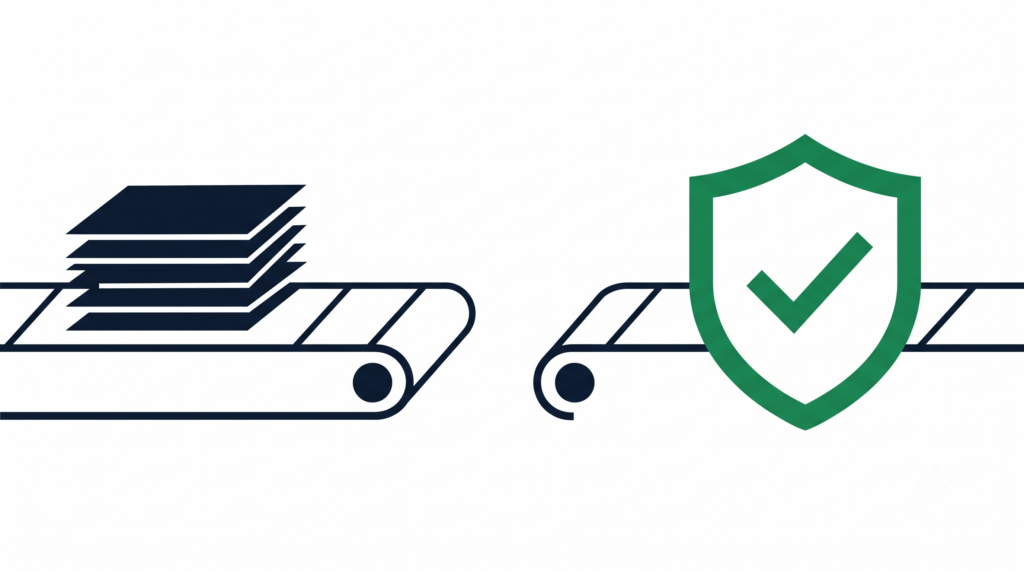

Your agents are producing the work – content briefs, on-page fixes, GBP updates, outreach, monthly reports. Output is up and cost per client is down. So the question on your desk is a fair one: do you keep running delivery on agents alone or do you add a human accountability layer on top?
Most of the debate around that question is about quality. Is the AI good enough yet? That’s the wrong frame, and it’s why the question never quite resolves.
The real worry isn’t whether an agent writes a decent title tag. It’s what happens when something breaks and whose name is on it, when it does. Yours, in front of the client you can’t afford to lose.
Isn’t This Just a Question of Whether AI is Good Enough?
It looks like one. Agents keep getting better at production, so the obvious take is that the need for human review shrinks as the models improve. Eventually the output is good enough and review becomes overhead.
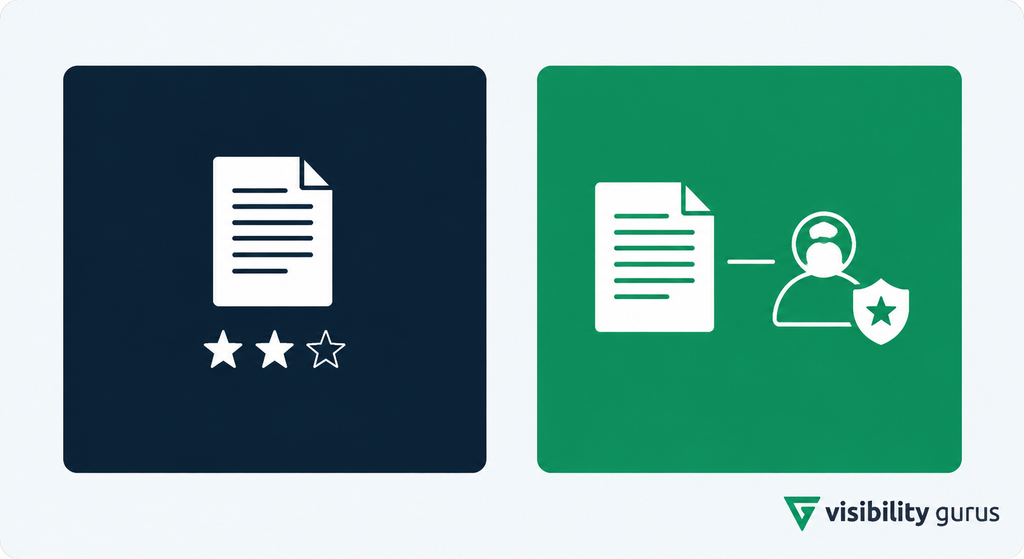
That take is incomplete because it treats quality and accountability as the same thing. They aren’t. Quality is a property of the output. Accountability is a property of the system around the output: who checked it, who owns it, and who explains it when a client asks.
A flawless deliverable that nobody in your agency understands is still unaccountable. And a slightly imperfect one that a named person verified, can explain, and will fix is something you can put in front of a client with a straight face.
What is the Accountability Gap?
The accountability gap is the distance between what your delivery system can produce and what it can answer for.
Agents close the production side fast. The answering side doesn’t move at all, because it’s made of people, standards, and ownership. So as you scale output, the gap widens. More work ships every month, and the number of people who can say why it shipped stays the same, or shrinks, because agents made it look like you needed fewer of them.
That’s the core of agent-only SEO risk. It will be not bad work but certainly unowned work.
What Actually Breaks When SEO Runs on Agents Alone?
In practice, the work itself is usually fine. The breaks happen in four places around it.
- Judgment at the edges – Beyond any doubt, agents are strong on the execution part but when it comes to determining whether the executed task is technically valid for a client or not, it fails. It can certainly swap a primary category, consolidate page or redirect, but can also quietly kill the scope of a converting URL.
- Pattern risk at scale – Agents simply repeat. If there’s a flawed template, they will produce the same output everywhere that template runs. Google’s spam policies on scaled content abuse target such pattern and the intent. So, a big concern for those who are only depending on AI output.
- Explanation – Suppose your client objects to anything regarding the deliverable generated by AI agents, will you use this answer “ the agent decided or did this”? No, right. At this point, agents actually break.
- Escalation – There are a few issues that require consistent attention and manual action like GBP suspensions, ranking drops. In such scenarios, agents can draft the reinstatement request but they can’t own the outcome.
Also want to mention that: Google isn’t against AI-produced content. Its guidance on AI-generated content is explicit that the major concern is only that content which is primarily made to manipulate rankings. The risk isn’t that anybody used agents. It’s that nobody is standing between the agents and your client.
How do You Tell If Your Delivery is Actually Accountable?
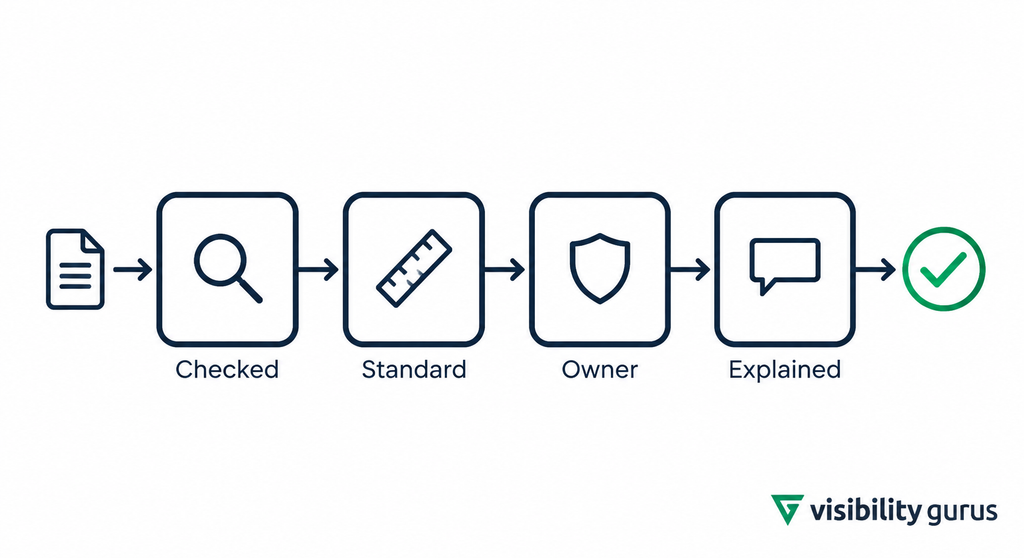
You can use the above Custody Test.
Let’s explain!
Pick any deliverable that shipped for a client last month and answer four questions about it.
- Who checked it? A named person, not “the pipeline” or “QA agent.”
- Against what standard? A written standard someone could audit, not a feeling that it looked right.
- Who owns it if it breaks? Including who picks up the escalation when it lands on a Friday.
- Who can explain it to the client in plain language, today? Without reconstructing it from logs first.
If you can answer all four with names, you have custody of that work. If the answers are “the agent,” “the prompt,” or “probably me,” you have a gap.
One trap: if the answer to all four is always your delivery lead, across every client, that isn’t custody. That’s a single point of failure wearing custody’s clothes.
What does the Gap Cost When it Opens?
Let’s make you understand it through an illustration – this is a constructed scenario and not a client story –
Picture an agency with 40 local-service clients. An agent pipeline handles GBP optimization and location pages for them. The delivery lead checks at what time deliverable is to be submitted only.
Now, suppose one of those clients is a multi-location dental group paying $3,000 a month, and it’s also the reference account the founder mentions on sales calls.
Here is how SEO proceeds in this scenario –
1. Optimization across locations – the agent adds a service keyword to the business name on several profiles. It reads like a reasonable ranking move but at the same time, it conflicts with Google’s guidelines for representing your business.
2. As a consequence, profile get suspended. And in the worst case, the client notices before the agency does. 3. When the delivery lead gets to know about this, they try to reconstruct what happened. There’s going to be a log of the change but no record of the reasoning and nobody remembers approving it, because actually nobody did.
4. There’s a log of the change but no record of the reasoning, and nobody remembers approving it, because nobody did.
5. Now seniors have to spend some time on corrections and a reasonable explanation.
6.Then, the founder has to take the client’s call. And the whole conversation will revolve around retention and not delivery.
Now see the cost logic – the visible cost is the senior hours diverted plus the client’s lost lead flow while profiles are down, which is the client’s loss but lands on your relationship.
So, the real cost is the retainer multiplied by however many months that client would have stayed, plus the referrals a reference account brings, plus the sales story you can no longer tell.
Against that, put the cost of verification on that one account. At Visibility Gurus’ Review-Only rate, that’s $450 a month.
So, the argument isn’t that this scenario happens often. We’re not going to invent a frequency for it. The argument is asymmetry: the cost of custody is fixed, small, and predictable. The cost of the gap is lumpy, unpredictable, and it lands on the relationships you can least afford to lose.
Why can’t Another Agent Close the Gap?
Because accountability isn’t a capability. It’s a commitment.
An agent can flag a risk, and it may even be right. A second agent reviewing the first adds a second opinion, which genuinely raises quality. But it doesn’t add an owner. Neither agent has a reputation at stake, can be held responsible, or will be on the call when the client is upset.
Stacking agents makes output better. It doesn’t create custody.
What Should You Change, Whether or Not You Hire Anyone?
This part is useful whether you ever talk to us or not.
- Separate your production from sign-off. Whoever (or whatever) produces the work shouldn’t be what approves it.
- Write the standard down. Especially for high-consequence changes: GBP names and categories, redirects, sitewide templates, disavows, link placements.
- Tier changes by consequence. Low-consequence work can ship on agent output. High-consequence changes need a named human sign-off before they go live.
- Name one owner per account. A person, not a queue or a shared inbox.
- Keep a rationale on file. For every significant change, a short paragraph explaining why, written so a client could read it.
- Report slow months honestly. A reporting layer that only knows how to celebrate is its own accountability gap.
Run the Custody Test again after a month of this. The gaps that remain are the ones worth paying to close.
Where Does Our Company “Visibility Gurus” Fit?
Getting the bigger picture, we’ve already built our service around this exact gap.
If you’d like to read its short version, here it is: Accountable white label SEO for AI-run agencies – your team produces and we verify, or we do it end to end. Either way, a named specialist from our end answers for everything that ships under your brand.
In Review-Only ($450/mo per client), your team and your agents keep producing. We verify, correct, and own what ships, with a named specialist per account, three-layer human review, escalation ownership for GBP suspensions, ranking drops, and penalties, and forwardable rationale docs you can send straight to clients.
If you’d rather hand delivery off entirely, our second plan – Full Fulfillment runs end to end across four tiers from $650/mo.
Both plans are month-to-month, with no contracts, an in-house team of 50+ full-time staff and 15+ years in SEO.
If your agency runs SEO delivery on AI agents and serves clients you can’t afford to lose, the fix isn’t a better agent but a named human who verifies and answers for the work, which is what Visibility Gurus’ Review-Only layer provides at $450 per client per month.
When the Opposite is True
We don’t say agent-only delivery is always wrong, it can be right and we’ll speak about that plainly too.
If your clients are small, churn-tolerant retainers, then you need not a human layer.
However, if your client pays a modest monthly fee, expects to churn within the year, and neither side expects anyone to answer for outcomes, adding per-client review can cost more than the relationship is worth.
Agent-only delivery is the honest model there.
The only mistake is selling that client accountability you aren’t providing.
If you already have custody in-house, you don’t need us. A senior person with real capacity, a written standard, and ownership of high-consequence changes passes the Custody Test. Your job is to protect that person’s time as volume grows, not to outsource it.
If your scope is genuinely low-consequence, say, supporting content on sites with no local profiles and no link work, the failure cost may be small enough that spot-checking is proportionate.
So Which Should You Choose?
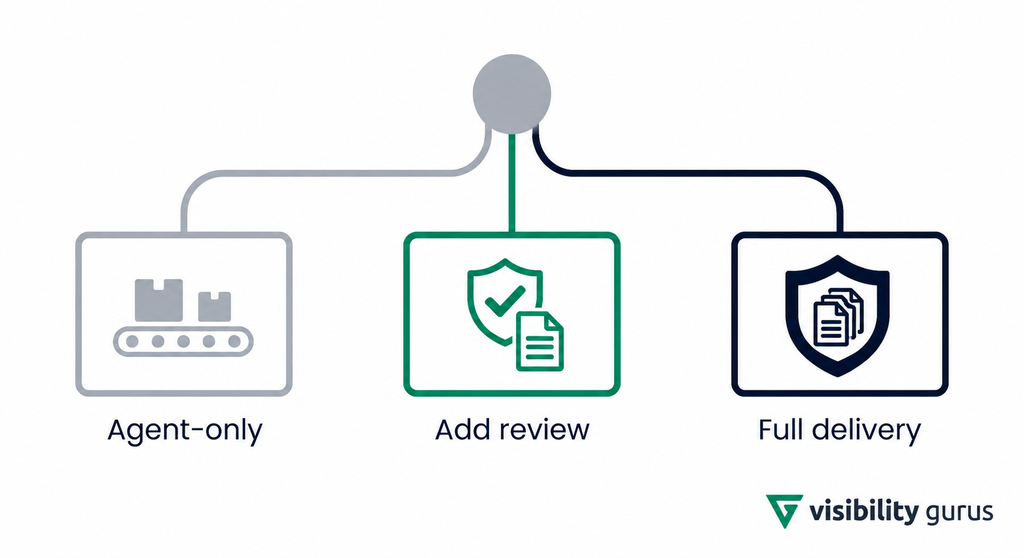
Choose agent-only delivery if…
- Your clients are small, short-tenure retainers and you price and scope them that way.
- Your scope excludes high-consequence changes like GBP edits, redirects, and link placements.
- You’re comfortable absorbing an occasional failure as a cost of doing business.
Choose a human accountability layer (in-house or VG Review-Only) if…
- Your team and agents already produce the work well, but the Custody Test turns up “the agent” or “probably me.”
- You have clients whose loss would hurt revenue, referrals, or your sales story.
- Your delivery lead is the only person who can explain what shipped.
Choose Full Fulfillment if…
- You don’t want to run production at all and would rather own the client relationship only.
- Your in-house pipeline is costing more senior time to manage than it saves.
Choose neither if…
- You already pass the Custody Test on every account with in-house people who have capacity.
- You’re not willing to change how work gets signed off.
If the Custody Test left gaps in your delivery, start a partner intake conversation with us. Tell us how your agents and team run delivery today, and we’ll show you where verification would sit, starting with a sample deliverable before you commit to anything.
FAQs
1. What is the accountability gap in SEO delivery?
Ans: It’s the distance between what an agency’s delivery system can produce and what it can answer for. AI agents scale production quickly, but ownership, verification, and client explanation don’t scale with them, so the gap widens as output grows.
2. What actually breaks when SEO runs on agents alone?
Ans: Usually not the work itself, but four things around it: judgment on edge-case changes, repeated errors at scale, the ability to explain changes to clients, and ownership of escalations like GBP suspensions or ranking drops.
3. How do you tell if your SEO delivery is accountable?
Ans: Apply the Custody Test to a recent deliverable: name who checked it, the written standard it was checked against, who owns it if it breaks, and who can explain it to the client today. Any answer that isn’t a named person is a gap.
4. Can another AI agent close the accountability gap?
Ans: A second agent can improve quality, but it can’t take ownership. Accountability requires someone with responsibility and reputation at stake who will fix and explain the outcome.
5. When is agent-only SEO delivery the right choice?
Ans: When clients are small, churn-tolerant retainers, scope excludes high-consequence changes, or the agency already has senior in-house people who verify and own high-risk work.